Where did the lesbian bars go?

I recently appeared on Kim Iversen’s show to discuss the disappearance of lesbian bars, the trans movement, and the changing landscape of the gay and lesbian community. You can view the episode in its entirety here.
There have been more than a few articles and documentaries around this topic.
Namely, The Lesbian Bar Project.
I have beef with them, however. My main issue is with this passage right here.
If what makes a bar uniquely lesbian is its ‘prioritization of marginalized genders including women’ then what the hell is a lesbian bar?
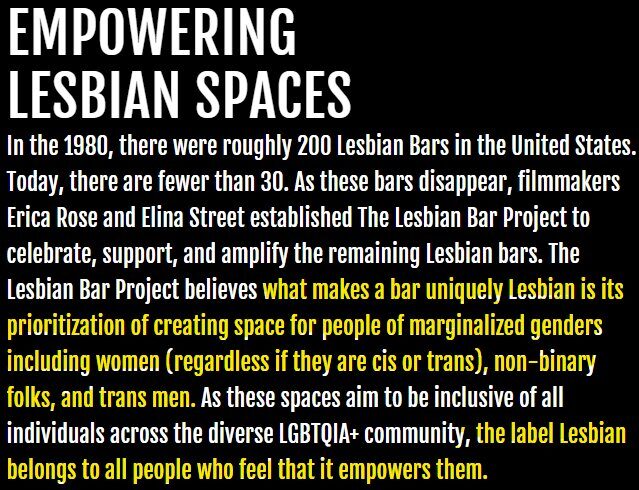
When you include everyone you always exclude someone.
Intersectionality and Inclusivity
The concept of intersectionality is fundamentally Marxist and also postmodern.
Intersectionality is a sociological analytical framework for understanding how groups' and individuals' social and political identities result in unique modes of discrimination and privilege.
When The Lesbian Bar Project says that a lesbian prioritizes marginalized genders this is what they mean. It’s a leftist dog whistle, if you will. They’re letting everyone know that everyone is welcome. By definition, there’s no need for a lesbian bar at all then. I believe that’s called a bar.
The Pink Hole
The best lesbian bar I’ve ever encountered was an underground club in Seoul, South Korea called The Pink Hole.
When I say underground, it was quite literally underground and located in a basement. You had to walk down a flight of stairs to be greeted by a door woman who would check your ID. Not only for age, but they specifically were checking for gender as well. There were absolutely 100% no men allowed. Being that Korean lesbians are quite androgynous they made sure to check one’s legal ID to make sure everyone was female.
The bar itself was fabulous. There were king sized beds donned in pink, frilly and laced, with beautiful women sitting on top. The dance floor was massive. The female DJs played K-pop and other dance music. The bar was large and cute Korean bartenders served drinks all night. What more could you ask for?
This was a lesbian bar.
Now, of course, you could attend if you weren’t a lesbian but not if you weren’t a woman.
The point isn’t about sexuality but rather about sex.
Single-sex spaces are what are disappearing due to the trans agenda. What started as a way for homosexuals to gather legally has turned into something that eliminated same-sex spaces for everyone.
Brief History of Gay and Lesbian Bars
Gays and lesbians existed in the shadows when homosexuality was illegal. “Coming out” as gay would have been dangerous and potentially illegal. In 1961, Illinois became the first state to decriminalize homosexuality and other states would slowly follow suit but not without much hullaballoo.
The Stonewall Riots
In the early hours on June 28, 1969, at the Stonewall Inn in Greenwich Village, New York City, the police arrived at Stonewall Inn, a popular spot amongst the gay community at the time. They began arresting patrons of the bar. Riots broke out. Over the next six days, demonstrations and clashes with police continued.
During this time, many gay rights organizations formed such as the Gay Liberation Front and the Gay Activists Alliance.
One year later, the first Gay Pride marches took place in New York City, Los Angeles, San Francisco, and Chicago on June 28, 1970, on the first anniversary of the Stonewall Riots.
So, bars are a really big deal for us gays.
It’s not the alcohol, though it’s part of it, but it’s the safe space aspect that bars enabled people to have when there weren’t any. It seems silly today in 2024 that gays and lesbians might need such a thing but it was critical at the time.
Without Stonewall, we may never have reached a point where the Supreme Court decriminalized homosexuality nationwide in 2003.
That’s right. 2003. Until then there were still sodomy laws in many states.
So, in a way, gay bars helped pave the way for the acceptance of homosexuality today.
In 2015, when same-sex marriage was legalized in the United States this completed the gay rights journey. All of the resources and organizations that were fundraising for same-sex marriage and other gay rights shifted to transgender rights. The next frontier of intersectionality, if you will.
What happened to lesbian bars?
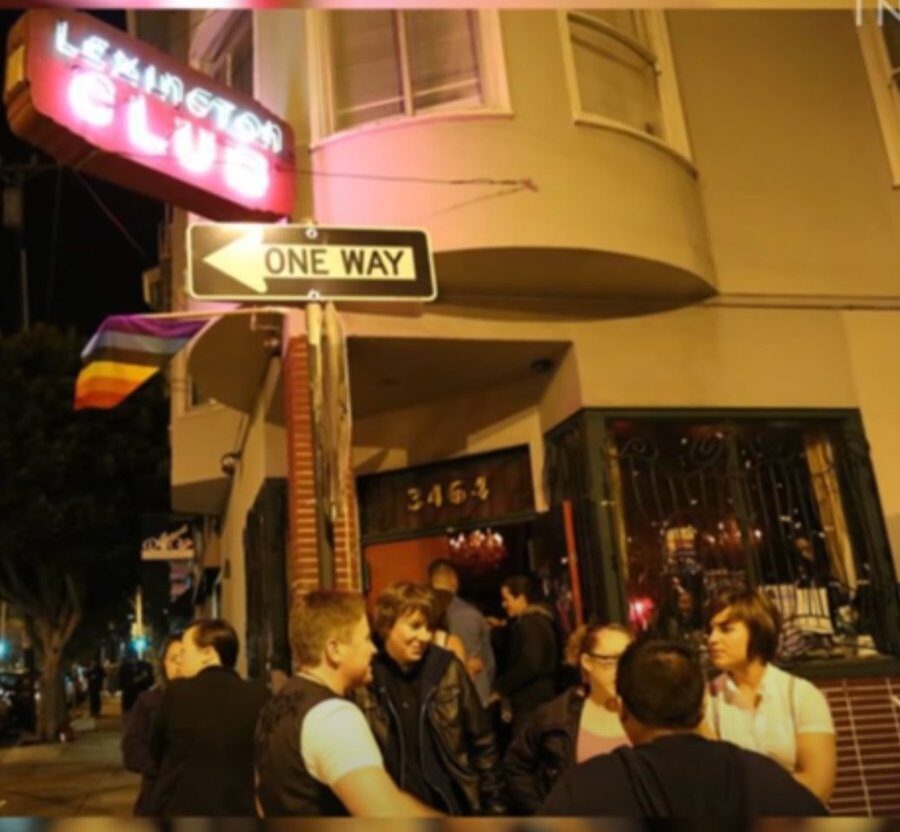
Yes, that’s me in the bottom right corner.
I remember this night. I volunteered to help save The Lexington Club (The Lex.)
The Lex was the last lesbian bar in San Francisco. They had asked for help with marketing. I gathered emails for their email list in exchange for free entry and a small bar tab. It was a fun night, but sadly The Lex closed shortly after that event. Business Insider did a short documentary called Why Lesbian Bars are Disappearing? and I happened to see the above photo pop up from that night, and I grabbed a screenshot.
When the Lexington closed in 2014, the owner since 1997, published this message on Facebook.
"As the neighborhood continued to change, we began to see sales decline, and they continued to do so. We tried new concepts, different ways of doing things, but we were struggling. When a business caters to about 5% of the population, it has tremendous impact when 1% of them leave. When 3% or 4% of them can no longer afford to live in the neighborhood, or the City, it makes the business model unsustainable."
As is often the case, the closures of these bars is blamed on economic conditions.
It’s true that lesbian bars make less money and attract less of a crowd than the gay bars. However, I tend to think there’s something else going on.
As I told Kim Iversen in our recent conversation, I believe the rise of transgenderism accelerated the decline of lesbian bars.
In the 1980s there were 200 lesbian bars and today there are 32 but, as far as I know, those 32 are all inclusive to all-genders.
The rise of trans and intersectionality
In 2007, we started to see the rise of social media. Tumblr in particular.
I recently stumbled (*ahem* tumbld) upon a paper that argued Tumblr is a “trans technology” and concluded that ‘Tumblr supported trans experiences by enabling users to change over time within a network of similar others, separate from their network of existing connections, and to embody (in a digital space) identities that would eventually become material.’
Oddly when Tumblr banned pornography in 2018, the author argues that this phenomenon failed to be relevant.
Further, before 2018 policy changes banning “adult” content, Tumblr upheld policies and an economic model that allowed erotic content needed for intersectional trans community building.
So, from 2007 - 2018, Tumblr and other social media pushed young people into trans ideology and intersectionality.
Remember the definition of intersectionality.
Intersectionality is a sociological analytical framework for understanding how groups' and individuals' social and political identities result in unique modes of discrimination and privilege.
Intersectionality is a fundamentally postmodern Marxist ideology that seeks to describe levels of oppression.
The whole idea is this:
If I’m oppressed then you’re oppressed and even though we’re oppressed in different ways those ways all intersect as oppression.
Confused yet?
So, if I’m a lesbian then I’m saying that I’m not straight. I’m identifying as being outside the norm. If someone is trans then they’re doing the same thing. So, we should be friends right?
Sure.
So trans women are women, right?
Wait, no.
Let me be fully clear.
Websites like Tumblr were pushing radical trans ideology, intersectionality, and other leftist thought through microblogging of adult content to minors. This led to less young people identifying as lesbians and rather as trans, non-binary, or queer. Therefore, the concept of a lesbian bar makes no sense to this demographic. By the time they would be frequenting such bars, they had no interest in doing so. Plus, they were probably spending too much time online looking at adult material to be interested.
Why does it matter?
You may be thinking, well lesbian bars aren’t really that important to everyone, Heidi. Fair enough. I get that. I never go out to bars anymore, so they aren’t that important to me. However, they are important to young lesbians.
I had a tweet that went viral after J.K. Rowling shared it. A young lesbian woman had contacted me and was concerned that there were no more woman-only spaces. This is sad to me. Tragic in fact. It’s sad because we can’t have same-sex spaces more than anything.
Some lesbians such as Jenny Watson are trying to start lesbian bars across the country and the world. I interviewed Jenny about her project in a Space on X.
Lesbians, like Jenny, who try to start a female-only bar quickly run into problems with violence, boycotts, and being banned outright.
While some of the “woke” lesbians on the left will fail to see this as an issue, old school lesbians, radical feminist lesbians, and conservative lesbians are rightly upset to see their safe spaces going away.
When you’re a woman who loves other women you do not have the privilege of having a man in your life to protect you from men with ill intentions. It’s a reality that all women know and especially lesbians. We depend on female-only spaces for our safety and to build a trusted social network.
If any Tom, Dick, or Harry can identify as a woman then this all goes away.
So, yeah, it matters. Not only to lesbians but to women and anyone who loves and cares about women.
What can be done?
I’ve spoken with many women and lesbians about these issues and I believe there are a few things that can be done.
Private events
We can hold completely private female-only events. Some type of gatekeeping will be required, of course. Usually in the form of paying for a ticket or perhaps having someone vouch for you. Lesbians would need decent private security to pull these off, but it can be done.
Communes
Yeah, communes. I know of one woman-only commune in Oregon called We’Moon. They’ve been female-only since 1973. There should be others, but they are becoming more scarce.
Boycotts
We shouldn’t support events like Dinah Shore weekend or other previously women-only events that now allow for men. Don’t go. Tell them why, if you’re brave enough, but please don’t give them your money.
Talk about it
Most people have no clue this is even an issue. Speak with your friends about it and let them know that it’s weird that lesbians don’t have female-only spaces anymore. The more people know, the better chance we have to recreate these spaces.
Support women-only events
There are still some women only events and some “lesbian” bars. According to The Lesbian Bar Project there are 32. You can see the list here.
If you have any ideas please do share them with me, and I’ll be sure to read them. Thanks again for your continued support. Together we can create more spaces that make sense for us all.